Friday, May 24, 2013

5/18/13


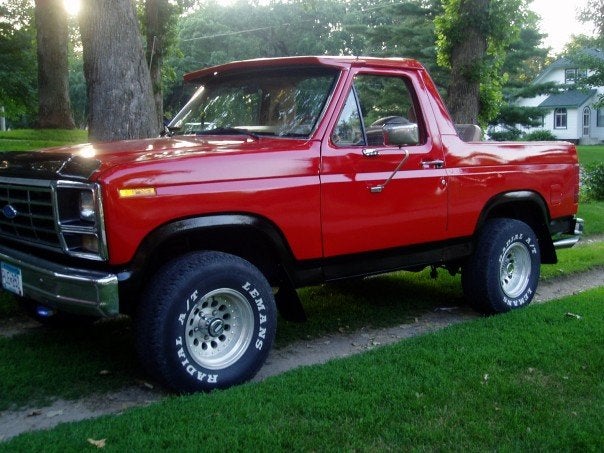
Today's car is the 1984 Ford Bronco. The Ford Bronco is a sport utility vehicle that was produced from 1966 to 1996, with five distinct generations. Broncos can be divided into two categories: early Broncos (1966–77) and full-size Broncos (1978–96).
The Bronco was introduced in 1966 as a competitor to the small four-wheel-drive compact SUVs such as the Jeep CJ-5 and International Harvester Scout, and built on its own platform.[1] A major redesign in 1978 moved the Bronco to a larger size, and it was built using a shortened Ford F-Series truck chassis to compete with both the similarly adapted Chevy K5 Blazer, and S-10 Blazer.
The full-size Broncos and the successor Expedition were produced at Ford's Michigan Truck Plant in Wayne, Michigan.
The Bronco was a television highlight viewed by millions on June 17, 1994, when a white 1992 model owned and driven by Al Cowlings with O. J. Simpson, who was wanted for the murders of his ex-wife and her friend, attempted to elude the Los Angeles Police Department in a low-speed chase.[2]
The Bronco received a major redesign for 1980, coinciding with the F-Series. The new Bronco was shorter, and had cosmetic changes along with powertrain, suspension and other odds and ends. Most notably, the live front axle was replaced by a Dana 44 Twin Traction Beam (TTB) setup in the front end for an independent front suspension. The TTB is a hybrid of a true independent front suspension and a solid front axle, with a "solid" axle that pivots around the differential and uses coil springs instead of leaf springs. The TTB system offered a higher degree of control and comfort both on and off road, but sacrificed wheel travel, and is notorious for being difficult to keep aligned when larger than stock tires are used.
With a smaller Bronco and fuel economy in mind, Ford offered a 300 cu in (4.9 L) straight six as the base engine. Though this engine came with more torque than the 302 cu in (4.95 L) V8 and comparable to the 351 cu in (5.75 L) V8 (until the High Output model), it was limited by a 1-bbl carburetor and restrictive single-out exhaust manifolds. Electronic emissions equipment added in 1984 further reduced the power of the inline six. Ford used up their remaining stock of 351M engines before turning over to the 351W in mid-model year 1982. A "High Output" version of the 351W became an option in 1984 and continued well into the 1987 model year until the introduction of fuel injection. Output was 210 hp (157 kW) at 4000 rpm vs the standard 2-bbl 351W which made 156 hp (116 kW) at 4000 rpm.[10] The 302 was the first engine to receive electronic fuel-injection, starting in the 1985 model year, as well as a four-speed automatic overdrive transmission. The Eddie Bauer trim package started in 1985 as well. From 1980 to 1984, some Broncos had sliding topper windows.
Cosmetically, Ford returned to their use of the "blue oval" logo on the front of a slightly redesigned grille, and removed the "F O R D" letters from the hood in 1982.[11] Power Low Mount Swing Lock mirrors were first offered in 1981.[12] Classic square mirrors and the optional power low mount swing lock mirrors were discontinued in 1986.

Third generation
Production 1980–1986
Body style Full-size SUV
Engine 300 cu in (4.9 L) Straight-6
302 cu in (4.95 L) 302 V8
351 cu in (5.75 L) 351M V8
351 cu in (5.75 L) Windsor V8
Transmission 4-speed Borg-Warner T-18 manual
4-speed New Process NP435 manual
4-speed Tremec RTS OverDrive
3-speed C6 automatic
4-speed AOD
Wheelbase 104 in (2,642 mm)
Length 180.4 in (4,582 mm)
Width 79.3 in (2,014 mm)
Height 75.5 in (1,918 mm)

Friday, May 17, 2013

5/17/13

Today we will look at the 2002 Honda Civic.
The Honda Civic is a line of subcompact and subsequently compact cars made and manufactured by Honda. The Civic, along with the Accord and Prelude, comprised Honda's vehicles sold in North America until the 1990s, when the model lineup was expanded. Having gone through several generational changes, the Civic has become larger and more upmarket, and it currently slots between the Fit and Accord.
It was introduced in July 1972 as a two-door model,[1] followed by a three-door hatchback that September. With the transverse engine mounting of its 1169 cc engine and front-wheel drive like the British Mini, the car provided good interior space despite overall small dimensions.[2][not in citation given] Early models of the Civic typically included a basic AM radio, heater, foam-cushioned plastic trim, two-speed wipers, and painted steel rims with a chromed wheel nut cap. As the years went by, it has become much more upscale with options such as air conditioning, power locks, power windows, leather upholstery, satellite-linked navigation, and a six-speed manual transmission. Initially gaining a reputation for being fuel-efficient, reliable, and environmentally friendly, later iterations have become known for performance and sportiness, especially the Civic Type-R, Civic GTi and Civic SiR.[3][4]
The Civic has been rebadged for international markets with such models as the Honda Ballade which became the British Leyland-produced Triumph Acclaim in Britain and Honda Domani/Acura EL. The Civic platform also served as the basis for the CR-X sport compact, the CR-X del Sol targa convertible, the Honda Concerto, the first generation Honda Prelude, the Honda Civic Shuttle (later to become the Honda Orthia), and the CR-V compact SUV. Starting in 1985 until 2006, the Civic was dedicated to Japanese dealership Honda Primo, with Civic variants sold at Honda Clio, and Honda Verno locations.
As of 2006, a total of 16.5 million Civics had been sold worldwide, with 7.3 million of them in the United States.[5] By 2012, Civic has been the top-selling car in Canada for 14 years.[6] With high gas prices and a weak economy in June 2008, the Civic supplanted the Ford F-Series to become the top-selling vehicle in the United States for that month.[7][8]
In Japan, production of non-hybrid Civic for domestic market ended in August 2010 and production of Civic hybrid for home market ended in December 2010. In recent years, customers shifted to minivans and compact cars like Honda Fit. Honda launched Fit hybrid in October in Japan. However, production of Civic and Civic hybrid for export markets will continue.[9]

The seventh generation was released in September 2000. While the redesign retained the previous generation's exterior dimensions, interior space was improved in part by using a flat rear floor thus bumping up Civic to a compact car size segment. The front suspension was changed from that of a double wishbone to a MacPherson strut, in order to lower costs, as well as allow more engine bay room for the newly introduced Honda K-series engine. Power was also increased on some trim levels. The three main trim levels were DX, LX, EX, and HX. The Civic Coupe was no longer sold in Japan starting with this generation.
In North America, coupe and sedan body styles were available, except for the Si (SiR in Canada) which was offered only as a three-door hatchback.[12] The rest of the world received three and five-door hatchbacks. The Type-R was redesigned as well this time using a more powerful i-VTEC motor and using the three-door hatchback body style. This generation saw Honda introduce their first Civic Hybrid, powered by a 1.3-litre engine.

5/16/13


Today's car is the 1966 Chevrolet Chevelle.
The Chevelle was intended to compete with the Ford Fairlane, and to return to the Chevrolet lineup a model similar in size and concept to the popular 1955-57 models. Enthusiasts were quick to notice that the Chevelle’s 115-inch (2,900 mm) wheelbase was the same as that of the 1955-57 Chevy. Two-door hardtop coupes, and convertibles, four-door sedans, and four-door station wagons were offered throughout the entire run. In line with other Chevrolet series, the two-door hardtops were called Sport coupes. Four-door hardtops, dubbed Sport Sedans, were available (1966 through 1972). A two-door station wagon was available in 1964 and 1965 in the base 300 series. Various wagons were sold with exclusive nameplates: Greenbrier, Concours, and Concours Estate. Six-cylinder and V8 power was offered across the board. The Chevelle was the basis for the Beaumont, a re-trimmed model sold only in Canada by Pontiac dealers through 1969.

Chevelle SS

1965 Chevelle Malibu SS396 Hardtop Coupe
The Chevelle SS represented Chevrolet's entry into the muscle car battle. Early 1964 and 1965 Chevelles had a Malibu SS badge on the rear quarter panel. Chevelles with the mid-1965 Z16 option, priced at US$1,501 in 1965,[2] had the emblem on the front fender as well as distinct in-house style numbers: 737 for the hardtop and 767 for the convertible.[3] The $162 Super Sport package was available on the upscale Malibu two-door hardtop and convertible models; the option added special exterior brightwork with SS emblems and the 14-inch full-disc wheel covers from the Impala SS. Inside, the vinyl bucket-seat interior featured a floor console for models equipped with the optional Muncie aluminum four-speed-manual or Powerglide two-speed automatic instead of the standard three-speed manual. Malibu SS also got a four-gauge cluster in place of engine warning lights, and a dash-mounted tachometer was optional. The available 283-cubic-inch four-barrel V8 engine rated at 220-horsepower was the same rating as the 1957 Chevy Power-Pak 283 engine.
While the 1964 Malibu SS may have recalled past glories, the new 'musclecar' future was available over at Pontiac. There, Chevelle’s Pontiac Tempest corporate cousin had a 389-cubic-inch V8 to create the 325 horsepower (242 kW) Pontiac GTO, and further optional 348 hp, followed quickly by the 310-horse 330-cubic-inch Oldsmobile Cutlass 442. That was all it took for Chevy to think about breaking GM's 330-cubic-inch ceiling for intermediate-car engines. Starting in mid-1964, the Chevelle could be ordered with the division’s 327-cubic-inch V8, in either 250 or 300 hp (224 kW). Both used a four-barrel carburetor and 10.5:1 compression, and could easily hold their own against 289 Ford Fairlane and 273 Plymouth Barracudas. But muscle fans would demand more, and get it. For 1965, Chevrolet also added the edgy 350-hp 327 V8 as Regular Production Option (RPO) L79. Still, for those “sensible” buyers, the Chevelle was also quite appealing, and Chevy built 294,160 the first year, including 76,860 SS models.[4] After 1965, the Malibu SS badge disappeared except for those sold in Canada. A limited 201 Malibu SS396 'Z-16' big-block-equipped cars were also eventually produced starting in late 1965 to confront still mounting competition, with most being built between mid-March and mid-April. But, strangely, they were handicapped by lack of a factory-offered positraction rear-end option to handle the 396's big torque. Of those original Z-16s, some 75 still exist and are accounted for.
1966 Chevelle Malibu Convertible
The Chevelle SS396 became a series of its own in 1966 with series/style numbers 13817 and 13867. SS396 sport coupes and convertibles used the same Malibu sport coupe and convertible bodies with reinforced frames and revised front suspension: higher-rate springs, recalibrated shocks, and thicker front stabilizer bar, but with different exterior trim. They also had simulated hood scoops, red-stripe tires, and bright trim moldings. The performance engines available included three, 396 CID V8s – the standard, rated at 325 hp (242 kW), an optional 360 hp (270 kW), and an optional 375 hp (280 kW), respectively (the mid-horsepower 396 was rated at 360 hp (270 kW) for 1966 only and 350 hp (260 kW) thereafter). The SS396 series lasted from 1966 through 1968 before being relegated to an option package in 1969. The 1966 and 1967 model years were the only two years of the 'strut back' 2-door sport coupe with its own style number, 17.[5]
In Canada, sporty Chevelles continued to wear "Malibu SS" badges for the 1966 and early 1967 model years. These Chevelles were available with the same equipment as non-SS Malibu models in the U.S., and did not get the domed hood or the blackout front and rear treatment. Redline tires were not available on Canadian Chevelles in 1966. A 1966 Malibu SS factory photo shows wheel covers on the car from the 1965 Impala. The Canadian Malibu SS got its "SS" name from the "Sports Option" package under RPO A51 and was primarily a trim option. This A51 option came with bucket seats, a center console (except when the three-speed manual transmission was ordered), standard full wheel covers, and the ribbed rocker panel moldings. The "Malibu SS" emblems were carried over from the 1965 Malibu SS series. This Canadian option could be ordered with any six-cylinder or V8 engine available at the time. Starting in January 1967, the Chevelle SS396 took over and became its own 138xx series, the same as in the U.S.
Z16 SS396
Only 200 regular production 1965 Z16 Chevelles were built at the Kansas City plant. The Z16 option included the convertible boxed frame, a narrowed rear axle and brake assemblies from the contemporary Impala, heavy-duty suspension, plus virtually all Chevelle comfort and convenience options. The Z16 standard big-block 396 Turbo-Jet V8 came only with the Muncie wide-ratio four-speed manual transmission. The rear panel of the Z16 had unique black and chrome trim which framed untrimmed Chevelle 300-style taillights (Malibu and Malibu SS models had bright metal lens trim).
The prototype Z16 Chevelle was built at the Baltimore plant. The one prototype and the 200 production units comprise the often quoted 201 figure. One convertible was reportedly special built for Chevy General Manager Semon "Bunkie" Knudsen, but is understood to have been destroyed. This Z16 conv for Z16-equipped Chevelles means this is one of the rarest, most coveted Chevrolets ever produced. Of the few that remain, prices run in six figures. Although some regular 1965 Chevelle owners have attempted to fake the Z16, this is a most difficult task due to the unavailability of the unique Z16 equipment and trim, although much of the external trim pieces are now being reproduced in the aftermarket.

New Body 1966–1967

1966 saw a complete restyle of the Chevelle on the previous frame that included smooth contours, a broad new grille and bumper treatment, and curved side windows. Bulging rear fender lines and a "flying buttress" roofline (tunneled into the "C" pillar) were highlights of the '66 hardtops, shared with other GM "A" body models. The new body reflected the "Coke bottle" body shape that became the fad for American cars in the mid-1960s. A 4-door hardtop-styled Sport Sedan joined the Malibu series. It was an attractive car and was offered through 1972, but never achieved the high-production figures as the pillared sedan. Chevelles continued in 300, 300 Deluxe, and Malibu trim. Available engines were a 327-cubic-inch V8 instead of either of the sixes, or the mid-level option, a 220-horsepower 283-cubic-inch V8. Judicious attention to the options list could add a tachometer, mag-style wheel covers, and sintered-metallic brakes. Four-way power seats, a tissue dispenser, and cruise control were optional.[6]
The 1967 models got some styling tweaks that resulted in a longer, more straightforward appearance. Large wraparound taillamps went into a new rear end with standard backup lights. Otherwise, visible change was modest. "What you'll see inside," claimed the sales brochure for the 1967 Chevelle, "will probably bring on a severe compulsion to go driving." Front disc brakes were available on all models, and a new dual master cylinder brake system incorporated a warning light. An entire host of new safety equipment became standard, including a collapsable steering column[7] making the 1967 models safer cars. The SS396 continued as its own series with both sport coupe and convertible body styles. The 375-horsepower 396-cubic-inch V8 was dropped from the options list until late in the model year and returned with little fanfare resulting in only 612 being sold. Buyers selected from no less than seven transmissions: two manual three-speeds, two manual four-speeds, an overdrive three-speed, and two automatics. The manual-shift feature of the Turbo Hydra-Matic transmission was touted in advertising. Options included Superlift air shock absorbers, Strato-ease headrests, and special instrumentation. Although Chevy's big news for 1967 was the introduction of the Camaro, Chevelle offered a more traditional sort of sportiness.

First-generation

1964 Chevrolet Malibu SS Hardtop Coupe
Also called Chevrolet Malibu
Production 1963–1967
Model years 1964–1967
Assembly Arlington, Texas, United States
Atlanta, Georgia, United States
Baltimore, Maryland, United States
Flint, Michigan, United States
Framingham, Massachusetts, United States
Fremont, California, United States
Kansas City, Kansas, United States
Van Nuys, California, United States
Oshawa, Ontario, Canada
Sainte-Thérèse, Quebec, Canada
Body style 2-door hardtop
2-door coupe
2-door convertible
2-door sedan
4-door sedan
4-door hardtop
4-door station wagon
2-door station wagon
Engine 194 cu in (3.2 L) Chevrolet I6
230 cu in (3.8 L) Chevrolet I6
250 cu in (4.1 L) Chevrolet I6
283 cu in (4.6 L) Small-Block V8
327 cu in (5.4 L) Small-Block V8
396 cu in (6.5 L) Big-Block V8
Transmission 3-speed manual
4-speed manual
2-speed automatic
3-speed automatic
Wheelbase 112 in (2,845 mm)
Length 197 in (5,004 mm)[1]
Curb weight 3,256 lb (1,477 kg)
Related Pontiac Tempest
Pontiac Le Mans, Buick Special, Buick Skylark, Oldsmobile F-85
Oldsmobile Cutlass
Acadian Beaumont, Beaumont, Chevrolet El Camino

5/15/13


The car today is the 1961 Lincon Continental.
In 1961, the Continental was completely redesigned by Elwood Engel. For the first time, the names Lincoln and Continental would be paired together outside the Mark Series; along with replacing the Continental Mark V, the 1961 Continental replaced the Lincoln Capri and Premiere, consolidating Lincoln into a single product line. Originally intended to be the 1961 Ford Thunderbird, the design was enlarged and slightly altered before being switched to the Lincoln line by Robert McNamara. One of the most striking features of the new Continental was its size. It was 14.8 in (380 mm) shorter than its predecessor. So much smaller was this car, that advertising executives at Ford photographed a woman parallel parking a sedan for a magazine spread. The new Continental's most recognized trademark, front-opening rear "suicide doors", was a purely practical decision. The new Continental rode on a wheelbase of 123 inches (3,100 mm), and the doors were hinged from the rear to ease ingress and egress. When the Lincoln engineers were examining the back seats that styling had made up, the engineers kept hitting the rear doors with their feet. Hinging the doors from the rear solved the problem. The doors were to become the best-known feature of 1960s Lincolns. To simplify production, all cars were to be four-door models, and only two body styles were offered, sedan and convertible. The 1961 model was the first car manufactured in the U.S. to be sold with a 24,000 mi (39,000 km) or 2-year bumper-to-bumper warranty.[15][16] It was also the first postwar four-door convertible from a major U.S. manufacturer.[17] Walnut-paneling was on the doors.[18]
Despite the smaller exterior dimensions, at 4,927 lb (2,235 kg), the new sedan was only 85 lb (39 kg) lighter than the lightest 1960 Lincoln four-door sedan (2 lb less than a two-door); at 5,215 lb (2,365 kg), the convertible outweighed its 1960 predecessor by 39 lb (18 kg).[19] As a result (save for their respective nine-passenger models) the new Lincoln was still heavier than anything from Cadillac.[20] or Imperial.[21] This solid construction led to a rather enviable reputation as "Corporate management was determined to make it the finest mass-produced domestic automobile of its time and did so."[22]
The 1961 Continental was Elwood Engel's Magnum Opus, as he was responsible for the complete design of the car. It was a sales success, with 25,160 sold during the first year of production.[23]
This generation of Continental is favored by collectors and has appeared in many motion pictures, such as Goldfinger, The Matrix, The Last Action Hero, Kalifornia and the Inspector Gadget films. It has also appeared in the television series Pushing Daisies, in the opening sequence of the television series Entourage, and as the vehicle of choice for Michael Chiklis's character Vincent Savino in the series Vegas. Ford produced several concept cars which recalled this design. In 2007, Lincoln's Navigator and MKX SUV lines adopted chrome grilles in the style of these Continentals.
1963 Lincoln Continental
1960–1961 Comparison[24][25] 1960 Continental 1961 Continental
Wheelbase 131.0 in (3,327 mm) 123.0 in (3,124 mm)
Overall Length 227.2 in (5,771 mm) 212.4 in (5,395 mm)
Width 80.3 in (2,040 mm) 78.6 in (1,996 mm)
Height 56.7 in (1,440 mm) 53.6 in (1,361 mm)
Front Headroom 34.9 in (886 mm) 33.5 in (851 mm)
Front Legroom 44.0 in (1,118 mm) 44.2 in (1,123 mm)
Front Hip Room 60.4 in (1,534 mm) 59.7 in (1,516 mm)
Front Shoulder Room 63.1 in (1,603 mm) 59.4 in (1,509 mm)
Rear Headroom 33.9 in (861 mm) 33.4 in (848 mm)
Rear Legroom–ins. 44.9 in (1,140 mm) 40.3 in (1,024 mm)
Rear Hip Room 65.2 in (1,656 mm) 60.7 in (1,542 mm)
Rear Shoulder Room 63.0 in (1,600 mm) 59.1 in (1,501 mm)
Luggage Capacity 29.2 cu ft (827 L) 15.5 cu ft (439 L)
This so-called "slab-side" design ran from 1961 to 1969 with few changes from year to year. Lincoln dealers began to find that many people who bought 1961 and post-1961 models were keeping their cars longer. In 1962, a simpler front grille design with floating rectangles and a thin center bar was adopted. Sales climbed over 20% in 1962, to 31,061.[26]
Due to customer requests, for 1963 the front seat was redesigned to improve rear-seat legroom; the rear deck lid was also raised to provide more trunk space. The floating rectangles in the previous year's grille became a simple matrix of squares. The car's electrical system was updated this model year when Ford replaced the generator with an alternator. For 1963, another 31,233 were sold.[27]
1965 Lincoln Continental
The wheelbase was stretched 3 in (76 mm) in 1964 to improve the ride[28] and add rear-seat legroom, while the roofline was squared off at the same time. The dash was also redesigned, doing away with the pod concept. Flat window glass was for additional interior space. The gas tank access door, which had been concealed at the rear of the car in the rear grille, was now placed on the driver's side rear quarter panel. The exterior "Continental" script was changed and the rear grille replaced by a simple horizontally elongated Continental star on the rear deck lid. 36,297 were sold that year.[29]
The convex 1962–1964 grille was replaced by a flatter, squared-off one for 1965. The car was given front disc brakes to improve stopping distances. For the first time, parking lamps and front turn signals were integrated into the front quarter panels instead of the bumper. Taillights were fitted with a ribbed chrome grille on each side. With the facelift, sales improved about 10%, to 40,180 units.[30] An oil pressure gauge was added.[15] Front seat belts with retractors were now standard.[31]
1966 Lincoln Continental four-door convertible
A two-door pillarless hardtop version was launched in 1966, the first two-door Lincoln since 1960, and the MEL engine was expanded from 430 cu in (7.0 L) to 462 cu in (7.6 L) cubic inches. The car was given all-new exterior sheet metal and a new interior. Parking lights and front turn signals went back into the front bumper, and taillights set in the rear bumper for the first time.[32] The length was increased by 4.6 in (117 mm) to 220.9 in (5,611 mm), the width by 1.1 in (28 mm) to 79.7 in (2,024 mm), and the height (on the sedan) by 0.8 in (20 mm) to 55.0 in (1,397 mm) high. Curved side glass returned, however tumblehome was less severe than in earlier models. The convertible saw a few technical changes related to lowering and raising the top. Lincoln engineers separated the hydraulics for the top and rear deck lid (trunk) by adding a second pump and eliminating the hydraulic solenoids. A glass rear window replaced the plastic window used previously. To lure potential Cadillac buyers, 1966 Continental prices were reduced almost US$600 without reducing equipment levels.[33] It succeeded, helping boost sales to 54,755 that year,[34] an increase of 36%,[34] all of it due to the new two-door;[34] sales of both four-door models slipped slightly.[34] Product breakdown for the year consisted of 65% sedans, 29% coupes, and just under 6% for the four-door convertible. 1966 was the first year a tape player was available and a new tilt steering wheel.[35]
The 1967 Continental was almost identical to the 1966. The most obvious external difference is that the 1966 model has the Lincoln logo on each front fender, ahead of the front wheel; this does not appear on the 1967 model. It was also the end for the four-door convertible,[36] down to just 2,276 units, a drop of 28% over 1966.[37] In addition to being the last production four-door convertible; at 5,505 pounds (2,497 kg)[38] the 1967 convertible holds the distinction of being the heaviest Lincoln since the Model K, and was even 55 pounds heavier[39] than the Cadillac Fleetwood Series 75 Limousine of that year. Total production was 45,667.[37] Warning lights on the dash included a cruise control on, trunk open, and an oil pressure light.[40]
Safety came to the forefront in 1967–68 and resulted in energy-absorbing steering columns, "safety" padded interiors, and lap safety belts for all passengers. 1968 saw shoulder belts for outboard front passengers as well.
1968 brought some exterior changes. The parking lights, taillights, and front turn signals were once again in a wraparound design on the fenders to satisfy Federal standards for side marker lights, but looked very different from those of the 1965 model. The new 460 cu in (7.5 l) Ford 385 engine was to be available initially, but there were so many 462 cu in (7.57 l) Ford MEL engine engines still available, the 460 was phased in later that year.[41] In April, the new Mark III made its debut, as a 1969 model.[42] Total sales would be down to just 39,134.[43]
1969 was the last production year with rear-opening "suicide doors", with few changes from 1968 (including the addition of federally-mandated head restraints).[44] Sales held steady at 38,383 for the Continental, plus another 30,858 for the new Continental Mark III.[45][45]
In the CBS television situation comedy Green Acres (1965–1971), in which the cars were furnished by Ford Motor Company, lead character Oliver Wendell Douglas (Eddie Albert) is shown driving a 1965 Continental convertible and then in later episodes owns a 1967 model.

Sales

Model Year Total Sales
1961 25,160
1962 31,061
1963 31,233
1964 36,297
1965 40,180
1966 54,755
1967 45,667
1968 39,134
1969 30,858
Media related to Lincoln Continental (fourth generation) at Wikimedia Commons

Kennedy Limousine SS-100-X

For the Kennedy White House, the Secret Service purchased a convertible parade limousine custom built by Hess & Eisenhart of Cincinnati, Ohio, from a 1961 Lincoln four-door convertible. Code named the SS-100-X, it was in this car that JFK was assassinated in 1963. By that time, the front of the car had been updated with the grille/headlight/bumper assembly from the 1962 model. After the assassination, the limousine was returned to Hess & Eisenhart, where it was repaired and retrofitted with full armor and a fixed roof. It subsequently continued in service for the White House for many years. This world-famous car is now on display at the Henry Ford Museum in Dearborn, Michigan.

Fourth generation
Model years 1961–1969
Assembly United States: Wixom, Michigan (Wixom Assembly)
Body style 2-door hardtop
4-door sedan
4-door convertible
Layout FR layout
Engine 430 cu in (7.0 L) MEL V8
460 cu in (7.5 L) 385-series V8
462 cu in (7.6 L) MEL V8
Transmission 3-speed Turbo-Drive automatic
3-speed C6 automatic
Wheelbase 1961–63: 123.0 in (3,124 mm)
1964–1969: 126.0 in (3,200 mm)
Length 1961: 212.4 in (5,395 mm)
1962–63: 213.3 in (5,418 mm)
1964–65: 216.3 in (5,494 mm)
1966–68: 220.9 in (5,611 mm)
1969: 224.2 in (5,695 mm)
Width 1961–65: 78.6 in (1,996 mm)
1966–69: 79.7 in (2,024 mm)
Height 1961–1963: 53.6 in (1,361 mm)
1964–1965: 54.2 in (1,377 mm)
1966–1968: 55.0 in (1,397 mm)
1969: 54.2 in (1,377 mm)
Curb weight 5,000–5,700 lb (2,300–2,600 kg)
Designer(s) Elwood Engel

5/14/13


Today's car is the 1997 Ford Mustang.
The Ford Mustang is an automobile manufactured by the Ford Motor Company. It was initially based on the platform of the second generation North American Ford Falcon, a compact car.[1] Introduced early on April 17, 1964,[2] and thus dubbed as a "1964½" model by Mustang fans, the 1965 Mustang was the automaker's most successful launch since the Model A.[3] The Mustang has undergone several transformations to its current fifth generation.
The Mustang created the "pony car" class of American automobiles—sports car-like coupes with long hoods and short rear decks[4]—and gave rise to competitors such as GM's Chevrolet Camaro,[5] AMC's Javelin,[6] as well as Chrysler's revamped Plymouth Barracuda and the first generation Dodge Challenger.[7] The Mustang is also credited for inspiring the designs of coupés such as the Toyota Celica and Ford Capri, which were imported to the United States.
The Ford Mustang was brought out five months before the normal start of the 1965 production year. The earliest versions are often referred to as 1964½ models, but VIN coded by Ford and titled as 1965 models[8] with production beginning in Dearborn, Michigan on March 9, 1964[9] and the new car was introduced to the public on April 17, 1964[10] at the New York World's Fair.[11]
Executive stylist John Najjar, who was a fan of the World War II P-51 Mustang fighter plane, is credited by Ford to have suggested the name.[12] John Najjar co-designed the first prototype of the Ford Mustang known as Ford Mustang I in 1961, working jointly with fellow Ford stylist Philip T. Clark.[13] The Mustang I made its formal debut at the United States Grand Prix in Watkins Glen, New York on October 7, 1962, where test driver and contemporary Formula One race driver Dan Gurney lapped the track in a demonstration using the second "race" prototype. His lap times were only slightly off the pace of the F1 race cars.
An alternative view was that Robert J. Eggert, Ford Division market research manager, first suggested the Mustang name. Eggert, a breeder of quarterhorses, received a birthday present from his wife of the book, The Mustangs by J. Frank Dobie in 1960. Later, the book's title gave him the idea of adding the "Mustang" name for Ford's new concept car. The designer preferred Cougar or Torino (and an advertising campaign using the Torino name was actually prepared), while Henry Ford II wanted T-bird II.[14] As the person responsible for Ford's research on potential names, Eggert added "Mustang" to the list to be tested by focus groups; “Mustang,” by a wide margin, came out on top under the heading: "Suitability as Name for the Special Car."[15][16] The name could not be used in Germany,[17] however, because it was owned by Krupp, which had manufactured trucks between 1951 and 1964 with the name Mustang. Ford refused to buy the name for about US$10,000 from Krupp at the time. Kreidler, a manufacturer of mopeds, also used the name, so Mustang was sold in Germany as the "T-5" until December 1978.
Mustangs grew larger and heavier with each model year until, in response to the 1971–1973 models, Ford returned the car to its original size and concept for 1974. It has since seen several platform generations and designs. Although some other pony cars have seen a revival, the Mustang is the only original pony car to remain in uninterrupted production over five decades of development and revision.[18]
In autumn 1993 the Mustang underwent its first major redesign in fifteen years. Code-named "SN-95" by the automaker, it was based on an updated version of the rear-wheel drive Fox platform called "Fox-4." The new styling by Patrick Schiavone incorporated several styling cues from earlier Mustangs.[44] For the first time since 1974, a hatchback coupe model was unavailable.
The base model came with a 3.8 OHV V6 (232 cid) engine rated at 145 bhp (108 kW) in 1994 and 1995, or 150 bhp (110 kW) (1996–1998), and was mated to a standard 5-speed manual transmission or optional 4-speed automatic. Though initially used in the 1994 and 1995 Mustang GT and Cobra, Ford retired the 302 cid pushrod small-block V8 after nearly 30 years of use, replacing it with the newer Modular 4.6 L (281 cid) SOHC V8 in the 1996 Mustang GT. The 4.6 L V8 was initially rated at 215 bhp (160 kW), 1996–1997, but was later increased to 225 bhp (168 kW) in 1998.[45]
For 1999, the Mustang received Ford's New Edge styling theme with sharper contours, larger wheel arches, and creases in its bodywork, but its basic proportions, interior design, and chassis remained the same as the previous model. The Mustang's powertrains were carried over for 1999, but benefited from new improvements. The standard 3.8 L V6 had a new split-port induction system, and was rated at 190 bhp (140 kW) 1999–2004, In 2001 the bhp was increased to 193.[46] while the Mustang GT's 4.6 L V8 saw an increase in output to 260 bhp (190 kW) (1999–2004), due to a new head design and other enhancements. There were also three alternate models offered in this generation: the 2001 Bullitt, the 2003 and 2004 Mach 1, as well as the 320 bhp (240 kW) 1999 and 2001,[47][48] and 390 bhp (290 kW) 2003 and 2004[49] Cobra.

5/13/13


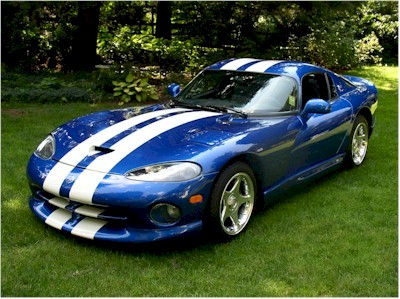
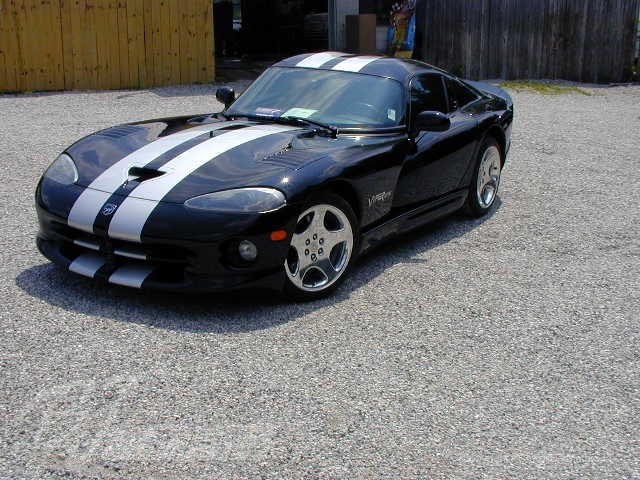
Today's car is the 2000 Dodge Viper. The 2000 Dodge Viper was called the Second Gen. Viper from 1998-2002.
A coupe model called the GTS was introduced in 1996. Dubbed "double bubble", the roof featured slightly raised sections above each seat to accommodate usage of helmets, a throwback to its intended purpose. Vipers can be seen participating often in drag racing and road racing. The GTS, like its predecessor, was chosen as the pace car for the 1996 Indianapolis 500.
Despite its similar outward appearance, the car was distinct enough to be considered a new generation model.[citation needed] Extensive modifications included a reworked engine with higher power and less weight, an almost completely redesigned chassis that was made 60 lb (27 kg) lighter and 25% stiffer in torsional rigidity through meticulous computer analysis, a thoroughly redesigned suspension, and reduced braking distances; the 1996 to 2002 Viper GTS had a lighter (approximately 650 lb (290 kg)) 450 bhp (340 kW) engine, which could complete the quarter mile in 12.3 seconds, 0.3 seconds and 16 mph (26 km/h) faster than its predecessor, and increased top speed by 11 mph (18 km/h) or so. The revised suspension, stiffer chassis, and aerodynamic body raised lateral grip to 0.98 g (9.6 m/s²), although other reports show the 1992 model with 1.0 g. Contemporary tires have improved upon this measure significantly. Slalom runs could often reach or exceed 70 mph (110 km/h). Brakes once again lacked ABS initially, and proved to be the car's weakest point. The brakes hurt the car in numerous comparison tests, such as a 1997 "supercar comparison" by Motor Trend, in which the Viper GTS placed at the top against cars such as the Ferrari 355, Chevrolet Corvette, Porsche 911 Turbo, Acura NSX-T, Mitsubishi 3000GT, and the Toyota Supra in all performance exercises except braking. The car not only placed last, but had considerably longer stopping distances than other vehicles. ABS was introduced further into the production run, though braking performance was not necessarily significantly improved. In a Sports Car International comparison conducted in 2002, the Viper ACR (with ABS) was compared to the 911 GT2 at Thunderhill Raceway Park. Both cars were very capable, and quick around the test track, but the Viper proved more difficult to drive, and the braking system was blamed very specifically for the gap in lap times (approximately GT2: 2 minutes, ACR: 2:04) between the two cars.
Along with the updated performance came the inclusion of some of the "luxuries" the car did without before. Dual front airbags were added to the vehicle's safety equipment list in 1996 on the GTS and 1997 on the RT/10 as mandated by the government. The car was also exported to Europe, where it was rebadged as a Chrysler, and sold under this marque from 1997 to 2003. European models had a detuned version of the Viper V10.
In the first six years of production almost 10,000 Vipers were sold. Minor evolutionary changes including new 18" diameter wheels and tires were introduced in the 1999 model. Subsequent versions featured light-weight hypereutectic pistons and an improved exhaust system, side exhaust having been dropped part way through production year 1996 for the RT/10; all production GTS Viper Coupes had rear exit exhaust. 1999 saw the introduction of the Cognac Connolly leather interior package. Continuing the refinements, ABS was introduced in 2001. In 2002, the end of second generation production was celebrated with the release of 360 commemorative "Final Edition" models. These models were painted red with white stripes, paying tribute to the famous race-winning Oreca cars. The RT/10 was replaced by the SRT-10 in 2003 and the GTS was replaced in 2006 by the SRT-10 Coupe.

Performance (GTS) (RT/10 from 1998–2002)

Dodge Viper second generation, phase II SR
  • 0-60 mph (97 km/h): 4.0 sec
  • 0-100 mph (160 km/h): 8.6 sec
  • quarter mile: 12.2 sec @ 119 mph (192 km/h)
  • top speed: 185 mph (298 km/h)
  • slalom: 73.6 mph (118.4 km/h)
  • skidpad average acceleration: 1.01 g (9.9 m/s²)

Sunday, May 12, 2013

5/12/13


Todays car is going to be the 2010 Chevrolet Camaro SS.
Although we're thrilled to have finally driven the with its throbbing 426-bhp V-8 (we'd previously only driven the V-6 version), we're positive the gobs of attention the car received during our photo shoot in San Diego, California, means that got this "modern interpretation of a classic car" thing just right — people were thrilled to be seeing the new Camaro; it didn't seem to matter if it was an SS V-8 or a V-6. Everyone seems to know this is the new Camaro the second they lay eyes on it, yet it's not merely a carbon-copy of the 1969 Camaro upon which designer Sang Yup Lee took his inspiration. And with the Camaro's purposeful hood power bulge, slightly shrouded headlights, menacing grille and foglights-as-DRLs, few cars on the road display a more aggressive face.
But let's get back to the Camaro SS and its V-8. Two 6.2-liters are available: Order the 6-speed automatic (which comes with shift buttons on the back of the steering wheel for manual control,) and you get the L99, which features Active Fuel Management (switching from 8 to 4 cylinders when driven at light throttle loads to save fuel) but lower power ratings of 400 bhp and 410 lb.-ft. of torque. Automatic-blip downshifts add a manly feel to this gearbox.
Order the Tremec TR6060 6-speed manual and you get to feel the power of Chevy's LS3 V-8 with 426 bhp at 5900 rpm along with 420 lb.-ft. of torque at 4600 rpm. Although the Camaro was designed/built with a price point in mind, Chevrolet didn't skimp on the necessities. All V-8 Camaros, plus V-6s with manual transmissions, come with limited-slip differentials — a must for good burnouts, power slides and true performance driving.
With 426 bhp and a 3860-lb. curb weight, the car hits 60 mph in 4.6 seconds and the quarter-mile in 13.0 at 111.1 mph. Those numbers basically equal the we previously tested with an automatic transmission, while they're significantly quicker than Ford's less powerful . Of note, the last Camaro Z28 we tested, in our November 2001 issue, hit 60 mph in 5.5 sec. and ran the quarter mile in 13.9, powered by a 310-bhp 5.7-liter V-8.
An interesting aspect of the new Camaro is Chevy's Launch Control, which functions when the stability system is set to its Competitive Driving mode. Launch Control manages wheelspin in 1st gear, as you keep the throttle pinned. Of note, we achieved quicker acceleration times managing wheelspin ourselves.
It's no secret that the new Camaro is a joint Australian/U.S. project. It's also no secret the Camaro rides on what is basically a shortened platform of Pontiac's G8. But unlike the G8, which is built in Australia, the Camaro is built at GM's Oshawa, Ontario, Canada, plant (production started March 16th). The G8's rear-drive platform means that for the first time in the Camaro's history, it has an independent multilink rear suspension, to go along with its MacPherson-strut front setup. Camaro SS models come with slightly stiffer spring rates, thicker anti-roll bars and a 0.5-in. lower ride height than V-6 versions.
Fitted with 245/45ZR-20 front and 275/40ZR-20 rear Pirelli PZero tires, our test car garnered 0.87g around the skidpad and 66.8 mph through the slalom. For comparison purposes, those are slightly better numbers than the Challenger SRT8 (0.85g and 65.0 slalom) but a far cry from the Track Pack-equipped Mustang GT (0.93g and 69.3 mph). Chevy currently doesn't have plans for a factory "track package" for the Camaro.
Out on the road, what the Camaro gives up in precision, it makes up in pure ride quality. This car is downright comfortable! And due to its independent rear suspension, bumps don't make the Camaro SS "hopping" mad. Sure, push the Camaro SS hard and you'll encounter a fair amount of understeer — there's no escaping the car's plentiful 3860-lb. curb weight. Luckily, the 14.0-in. 4-piston Brembo front brakes (14.4 at the rear) are up to the task of getting the Camaro SS slowed down quickly.
In lower speed corners, you can use the massive amounts of V-8 power to steer the Camaro SS with the throttle. Which is just plain good fun! The 6-speed manual, although not the quickest shifting ever, is easy to use and has positive gates, while pedals are placed close enough for reasonable heel-and-toeing. The front seats are clearly made for wide Americans, but despite this they offer good lateral support and comfort aplenty. Limited rear head room defines the Camaro as a 2 + 2.
The EPA rates the Camaro V-6 with the 6-speed manual at 17 mpg city/ 29 mpg highway. The manual SS is rated at 16/24, (with the automatic a tad better at 16/25). At $22,995 for the LS V-6, and $30,995 for the SS, we rate the new Camaro as great news for Americans. Chevy says the first Camaros will hit dealers at the beginning of April. The Camaro later became the 2013 Chevrolet NASCAR Nationwide Series car.